
ShadowM's Commodore 64 Software Page
(last updated 2010-10-31) |
ShadowM's Commodore 64 Software Page(last updated 2010-10-31) |
|
Here's where I put software and other files that people have asked me for a copy of (there is also a GEOS page and an operating systems and compilers page). Some of it I've prepared from my own collection; some of it has been collected from various locations. Most of it is in D64 format (see articles by Peter Schepers and Ruud Baltissen). Since I've never owned a 128, all the software is for the C64 unless otherwise noted. A lot of the docs are missing, but I'll address that as time permits.... If there's something in particular you're looking for, you can email me (shadowm at lyonlabs.org) for help finding it.
Tools for Learning and Cracking Copy Protection
Articles
Utilities
Odds & Ends
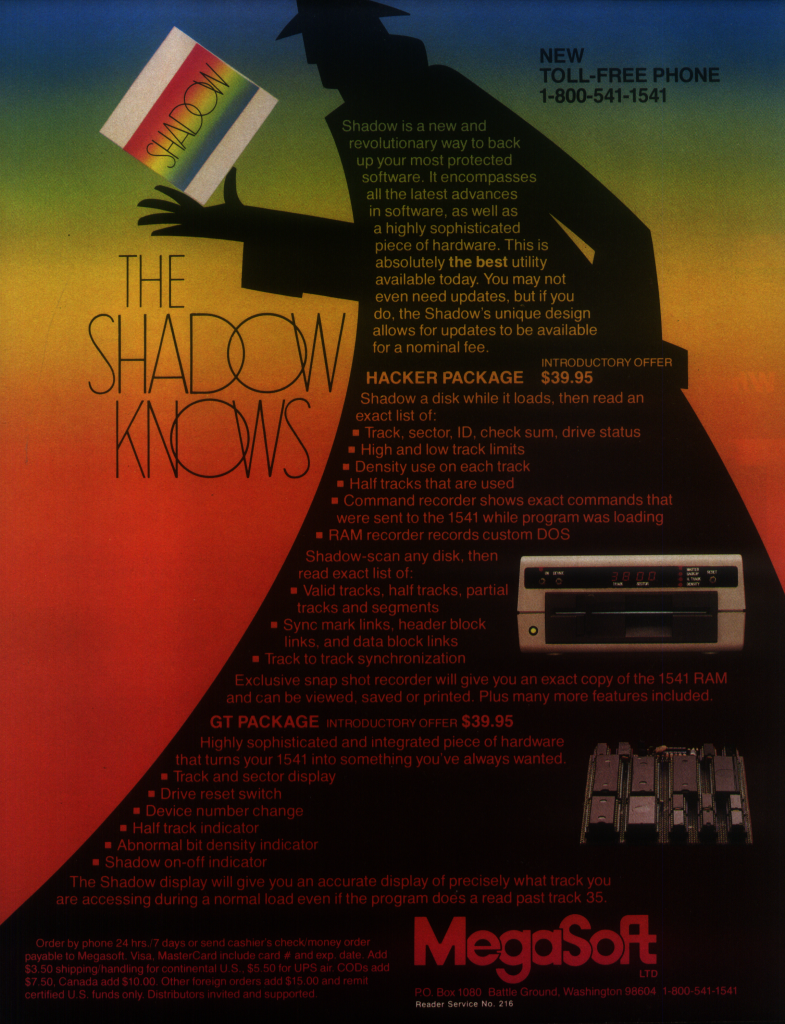
Although I've never owned one of these, I've always loved the name. The ad was scanned from a copy of Ahoy! magazine that I picked up at the World of Commodore Expo in December 2007 (click for a larger view).
The best place to start learning is probably Inside Commodore DOS by Immers & Neufeld. It starts by taking you through the superficial structure of a disk, and eventually leads up to more complex subjects like GCR encoding.
This is a PDF of the presentation on copy protection I gave at World of Commodore 2007. It gives an overview of protection methods, with drive code samples for common tasks like reading/writing sync and data, switching density, stepping the head, &c. There are also a couple of protection disassemblies.
Disk/Extramon and Megamon These are some very good memory-resident machine language monitors. Megamon has a very good single-step feature (unusual in memory-resident monitors); Disk/Extramon was featured in Transactor magazine Volume 05, Issue 06 and has excellent facilities for exploring the memory of the 1541 drive as well as that of the C64. Documentation files are on the disk.
ZipCode V2 This is a crack of a great set of high-level disk utilities. Although the original is only lightly copy-protected, the code surrounding the protection is maddeningly obfuscated (partly to do with a fastloader). The original says "ShareWare by A.L. Peters" when it boots (and doesn't show decompression characters on the lower right as each module loads). If you want a real original, you can boot the crack and use it to extract a "six-pack" archive I made of my own copy (this type of disk archive was designed to copy disks with light protection, and takes up more space than the original disk). It's a roundabout process, but it works. Here's how to do it:
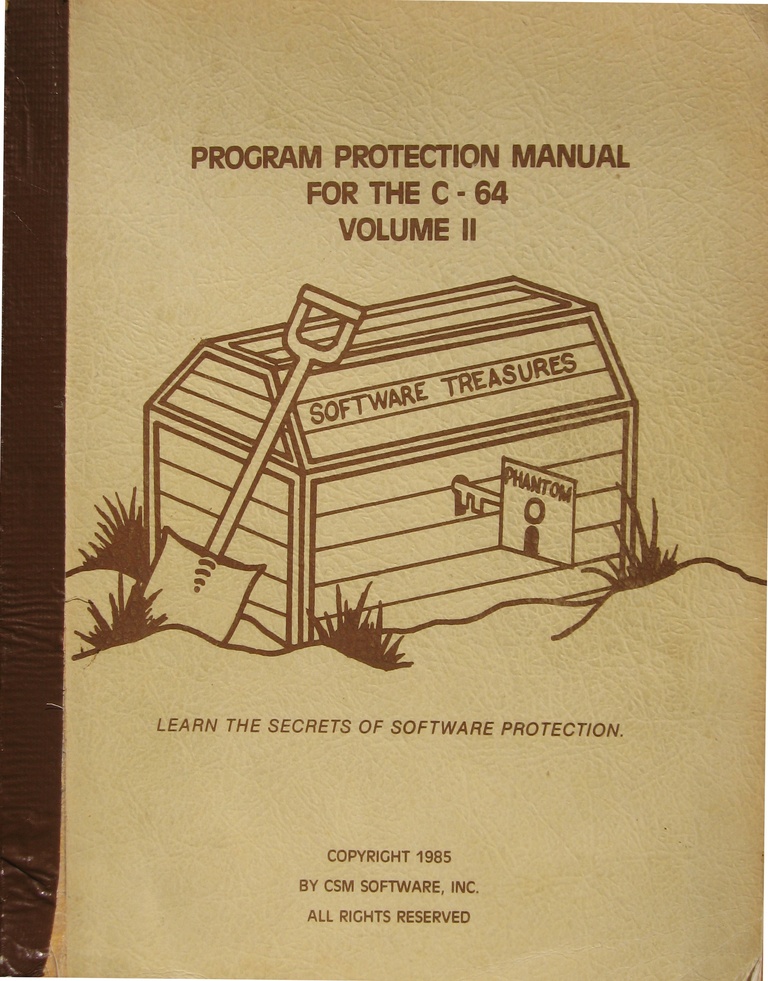
Here it is: the one, the only (click for a larger view).
The CSM Program Protection Manuals, long considered fabulously rare, have now been scanned for posterity. Volume II is legendary for its discussion of advanced copy protection topics, including extra sectors, spiral tracking, altered density, and more.
CSM Program Protection Manual, Volume I This is the manual itself, scanned to a PDF (thanks to Christian Lott for getting it down to a reasonable size), and here's an image of the disk that goes with it. You may notice a passage in the manual that says "The directory of the disk has been modified to prevent you from listing it... other modifications have been made. See if you can find them all." I have done my homework, and here is a working copy of the disk.
CSM Program Protection Manual, Volume II This book, which runs to almost 300 pages, is one of the bibles of copy protection, from basics to advanced. And here is an image of the disk that goes with it, which consists mostly of code examples from the book. The assembler sources are in BASIC program format, so load 'n' list to read them.
KrackerJax Revealed was a series of three booklets explaining how the fine folks at KrackerJax broke the protection on so many titles and how the protections worked (including custom disk formats like V-MAX! and RapidLok). The booklets were later released as a trilogy (PDF of all three volumes).
KrackerJax Revealed Volume I. This is the disk that came with Volume I.
KrackerJax Revealed Volume II This disk includes the RapidLok copiers.
KrackerJax Revealed Volume III This disk features the Hackers Utility Kit, a set of extremely powerful disk utilities including a GCR editor (hit H for the help screens in the GCR editor).
GEOS Busters 4.0, also from KrackerJax. The disk label says "Click in geosbusters v4.0 from GEOS(tm) desktop. View or print documentation file from geoWrite(tm)".
Here is a link to the documentation, scanned by DLH. Maverick 5.03 was released on four disks, three of which were flippies:
Parameter Upgrades, side B Note
that there is no directory on side B.
Here are some links to articles about the infamous Commodore DOS bug involving relative files. Relative files are very powerful, and you shouldn't be afraid to use them if you know the workaround. (Transactor pages courtesy Craig Bruce.)
Beyond Raid also contains references to some other articles on relative files.
Here are the "plus" versions of the CMD utilities (side A and side B). Side B includes Menuette, a menu-driven file explorer for the CMD devices.
ARC Long ago in the
days of our ancestors, before ZIP and JAR, there was ARC, an
archiver/shell that was the Swiss army knife of its day. This disk
image contains ARC, its documentation, and ARC-SDA, a program used to
create Self-Dissolving Arc files (SDA files
decompress automatically when they are loaded and run). This copy of
ARC-SDA looks like it was created with ISEPIC, so start it with the
command LOAD "ARC-SDA V4.6",8,1. The ARC-SDA
docs are also on this image.
Super Aide (and the docs). This is a set of BASIC programming utilities, including renumber, autonumber, find and replace, append, bi-directional scroll, variable list, etc. Run the documentation reader on the docs disk for full details.
SuperSnapshot is one of the best utility cartridges ever made, but by the time it had reached version 5, the code didn't all fit in the cartridge and some menu entries asked you to "insert system disk". Here are D64 images of side 1 and side 2 of that disk. If you are looking for a SuperSnapshot, Joe Palumbo still sells them; the manual is available at Project64.
Here's a D64 image containing a bunch of terminal programs, including X-Term, Touchterm, CCGMS 5.5, and Laser Term.
Looking for a good copy program? Commander 64 (D64 disk image) can browse and copy files between a wide variety of Commodore devices, including the CMD devices and the uIEC.
This is a D81 image of the KrackerJax 1581 Toolkit, and here's the manual, scanned by the indomitable DLH.
Q-Link had an all-purpose file decompression and conversion utility called Omega-Q.
3001 Sound Odyssey
3001 Sound Odyssey (D64 image with copy protection removed), was released by Sight & Sound in 1984, and is a good way to learn the ins and outs of the SID chip's settings. There are also about 100 preset combinations of the three voices that are a lot of fun, and you can use your keyboard to play on. (This is the software whose companion product is the "Incredible Musical Keyboard", which is a piano-style keyboard that fits over top of the C64's keys.) Here's the instruction booklet scanned to a PDF document.
This is Commodore's Micro Astrologer, and here are the docs as a PDF. I cracked the protection myself (three sets of NOPs to defeat the protection check, then re-encrypt the portion of memory read from the loader's first sector and write it back to disk). This program is a good introduction to the Ancient Art for those who are interested.
Here's the El Gato REU page-flipping demo; it does smooth animation of a cat walking while turning the frame over from right to left with the perspective changing. You may want to turn off everything but drive 8 for this one.
This is a tarball (about 80M in size) of the contents of the CD that DemongerX made to give away at ECCC 2006. The CD's volume label is "CBM_COLLECTION", and the disc is labeled "Commodore Collection V1.0" and "Demos, Sids & C/G". It also contains a scan of the 1988 Q-Link Software Guide.